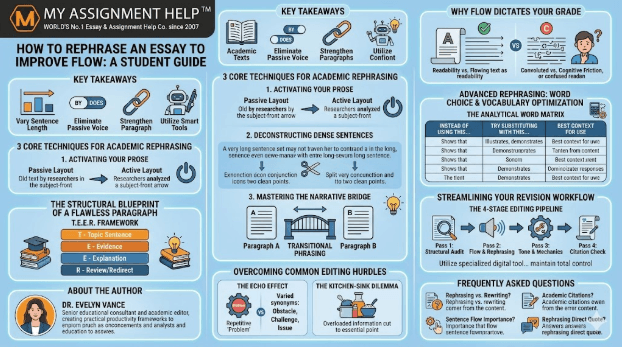
Writing a comprehensive rough draft is only half the battle in college writing. The real magic happens during the editing phase, where raw ideas are polished into a cohesive, high-scoring academic paper. Many students struggle with the mechanical transition from a messy first draft to a clear, authoritative final submission.
When your thoughts feel fragmented or your paragraphs lack narrative progression, learning how to restructure your prose is vital. Developing a systematic approach to editing ensures your arguments remain central while your sentence structures stay highly engaging.
Key Takeaways
- Vary Sentence Length: Mix short, punchy declarative statements with longer, complex sentences to create a dynamic reading rhythm.
- Eliminate Passive Voice: Shift passive constructions into active ones to make your academic arguments sound more authoritative.
- Strengthen Paragraph Transitions: Use clear signposts (e.g., consequently, furthermore, conversely) to bridge distinct ideas seamlessly.
- Utilize Smart Tools: Leverage reliable editing resources to break through writer’s block and reorganize convoluted phrasing.
Why Sentence Flow Dictates Your Final Grade
When a professor sits down to grade a stack of essays, they look for more than just accurate data and correct citations. They look for readability. A paper with excellent flow allows the reader to glide from one argument to the next without pausing to decipher convoluted syntax. Conversely, a paper with poor flow forces the grader to reread sentences multiple times, creating cognitive friction that can drag down your overall score—even if your research is flawless.
Many students mistake complex writing for advanced writing. They fill their paragraphs with overly long words and winding clauses, thinking it makes them sound more scholarly. In reality, true academic authority stems from clarity. Rephrasing your essay during the revision stage is the only way to strike the perfect balance between intellectual depth and accessible communication.
3 Core Techniques for Academic Rephrasing
1. Activating Your Prose
Passive voice often creeps into college papers, making arguments sound detached, ambiguous, and clunky. By identifying passive constructions and shifting the true subject of the action to the front of the sentence, you instantly inject energy and clarity into your writing.
- Passive Layout: “The historic economic data was analyzed by the research team over a three-month period.”
- Active Layout: “The research team analyzed the historic economic data over a three-month period.”
Notice how the active version is shorter, more direct, and positions the researchers as the clear drivers of the action. While passive voice is occasionally acceptable in scientific methodology sections, the active voice should dominate your argumentative essays.
2. Deconstructing Dense Sentences
Academic writing requires analytical depth, but packing too many clauses into a single sentence leads to rapid reader fatigue. If a sentence runs longer than three lines of text, it is a prime candidate for deconstruction. Look for logical breaking points—such as conjunctions like and, but, or which—and split the sentence into two distinct points.
- Before: “Although the initial results indicated a significant correlation between the two variables, the sample size was too limited to draw definitive conclusions, which led the team to recommend a secondary study.”
- After: “The initial results indicated a significant correlation between the variables. However, because the sample size was too limited to draw definitive conclusions, the team recommended a secondary study.”
3. Mastering the Narrative Bridge
A brilliant introductory hook sets the stage, but individual body paragraphs must sustain that initial momentum. Reviewing practical essay hook examples can provide immediate inspiration for structural openings. Once you establish an engaging opening framework, you must maintain a strong narrative bridge across every subsequent paragraph using intentional transitional phrasing.
Advanced Rephrasing: Word Choice and Vocabulary Optimization
Rephrasing is not just about moving words around; it is about choosing the right words for the specific academic context. Repeating the same verbs and transitions over and over signals a limited vocabulary to your grader. To elevate your essay, focus on expanding your transitional vocabulary and substituting weak verbs with strong, analytical alternatives.
The Analytical Word Matrix
| Instead of Using This… | Try Substituting with This… | Best Context for Use |
| “Shows that” | Illustrates, demonstrates, highlights, exemplifies | Introducing empirical evidence or a data point. |
| “And” | Furthermore, moreover, in addition, additionally | Adding a supporting layer to an existing argument. |
| “But” | Conversely, on the other hand, alternatively | Introducing a counter-argument or a point of contrast. |
| “Because of this” | Consequently, as a result, hence, therefore | Linking a cause directly to its logical academic effect. |
By systematically replacing basic conversational terms with these precise academic markers, you instantly upgrade the structural tone of your writing without changing your underlying thoughts.
The Structural Blueprint of a Flawless Paragraph
To build an essay that flows beautifully, you must treat every individual paragraph as a mini-ecosystem. A perfectly structured paragraph should rarely exceed 150 to 200 words and should focus on a singular, unified point. When a paragraph gets too long, it usually means you are trying to force multiple arguments into the same space, which destroys your sentence flow.
Use the T.E.E.R. framework to ensure your paragraphs remain structurally sound:
- T – Topic Sentence: Clearly state the main claim or focus of the paragraph.
- E – Evidence: Present the data, quote, or historical fact that supports your claim.
- E – Explanation: Analyze the evidence. Explain why this data proves your topic sentence true.
- R – Review/Redirect: Conclude the thought and create a logical bridge to the next paragraph.
If you follow this rhythmic structure, your text will naturally develop an engaging cadence that keeps your reader locked into your analytical perspective.
See also: How Smart Devices Are Enhancing Healthcare Monitoring
Streamlining Your Revision Workflow
The manual revision process can be incredibly time-consuming, especially when balancing a heavy semester course load, preparing for finals, or working part-time jobs. Modern college students frequently optimize their editing schedules by combining manual editing steps with smart digital tools. Trying to fix grammar, structure, tone, and citations all at once is overwhelming. Instead, break your revision phase into dedicated passes.
The 4-Stage Editing Pipeline
[Pass 1: Structural Audit] ➔ [Pass 2: Flow & Rephrasing] ➔ [Pass 3: Tone & Mechanics] ➔ [Pass 4: Citation Check]
- The Structural Audit: Read through your paper solely to verify that your thesis statement is clear and that your paragraphs follow a logical order.
- The Flow & Rephrasing Pass: Focus entirely on reading your prose aloud. If you stumble over a sentence, mark it for rephrasing to make it smoother.
- The Tone & Mechanics Pass: Hunt down passive voice, eliminate repetitive vocabulary, and clean up punctuation errors.
- The Citation Pass: Double-check every in-text citation against your reference list to guarantee total compliance with your rubric (APA, MLA, or Chicago).
When deadlines are exceptionally tight and structural clarity is compromised, utilizing a specialized digital tool to rewrite my essay allows you to rapidly explore alternative vocabulary choices, fix rhythm issues, and elevate the overall tone of your work. This structural assistance allows you to maintain total control over your unique thesis arguments while ensuring the final output meets stringent institutional rubrics.
Overcoming Common Editing Hurdles
The Echo Effect
The “Echo Effect” happens when you use the exact same word multiple times within a single paragraph. For example, using the word “problem” four times in five sentences makes your writing sound repetitive and unpolished. During your rephrasing pass, look for these repetitive echoes and use a thesaurus to find contextual synonyms like “obstacle,” “challenge,” “issue,” or “complication.”
The Kitchen-Sink Dilemma
Many students fall into the trap of trying to include every single piece of information they found during their research phase. This creates cluttered, exhausting paragraphs that distract from your primary argument. If a piece of data does not directly support your thesis statement, cut it out. True editing is as much about what you remove as it is about what you keep.
Frequently Asked Questions
How does rephrasing differ from rewriting?
Rephrasing focuses on altering the word choice and sentence layout of a specific text segment to improve its clarity or tone while keeping the core meaning identical. Rewriting is a broader process that often involves restructuring entire arguments, adding new data, or changing the overall direction of an entire paper.
Will changing sentence structures impact my academic citations?
No. As long as the core data and ideas are accurately attributed to the original source, rephrasing sentences to improve flow does not alter your citation obligations. Always ensure your formatting matches your specific style guide (e.g., APA or MLA).
Why is sentence flow so important to college graders?
Professors look for clarity and logical progression. A paper with poor flow forces the reader to work harder to understand your arguments, which often obscures the actual depth of your research and lowers your overall rubric score.
Can I rephrase a direct quote?
If you change the wording of a direct quote, it is no longer a quote—it becomes a paraphrase. Paraphrasing is highly encouraged in academic writing because it shows you actually understand the source material well enough to explain it in your own words. Just remember that paraphrased ideas still require a proper citation.
About the Author
Dr. Evelyn Vance is a senior educational consultant and academic editor with over a decade of experience guiding undergraduate students through complex writing processes. She specializes in creating practical productivity frameworks for modern learners and contributes to the design of advanced academic support tools, including the interactive MyAssignmentHelp writing suite.