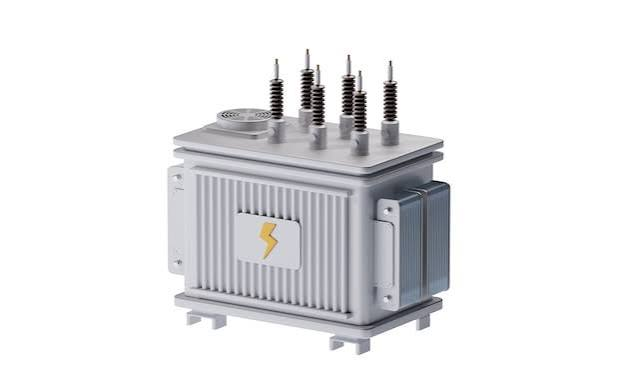
Electrical systems depend on transformers to deliver power at the voltage required by different types of equipment. Not every installation needs a large transformer. Small commercial buildings, workshops, farms, offices, and light industrial facilities may have moderate electrical requirements that can be served by a 50 kva transformer.
The 50 KVA rating places this transformer in a useful range for installations that need more capacity than a small residential transformer but do not require the larger equipment used by major industrial facilities.
Understanding the 50 KVA Rating
KVA, or kilovolt-amperes, indicates the apparent power capacity of a transformer. A 50 kva transformer is designed to handle an apparent load of 50 KVA under its specified operating conditions.
The equivalent real power depends on the power factor of the connected load. For example, at a power factor of 0.8:
50 KVA × 0.8 = 40 kW
At a power factor of 0.9:
50 KVA × 0.9 = 45 kW
These figures are examples rather than universal operating limits. Actual transformer loading depends on its design, cooling arrangement, ambient temperature, insulation system, and manufacturer specifications.
Where 50 KVA Transformers Are Used
A 50 kva transformer can serve a variety of electrical installations with moderate power demand. Common applications include:
- Small commercial buildings
- Workshops
- Agricultural facilities
- Warehouses
- Retail outlets
- Offices
- Small manufacturing units
- Schools
- Residential developments
- Pumping systems
The correct application depends on the site’s load profile. Equipment such as motors, pumps, compressors, and welding machines can have starting or intermittent demands that need to be considered during transformer selection.
The Importance of Load Assessment
Selecting a transformer begins with determining how much power the facility actually requires.
Adding the nameplate ratings of every electrical device does not necessarily produce the transformer’s required capacity. Some equipment may operate only occasionally, while other systems may run continuously.
Engineers may evaluate:
- Connected load
- Maximum demand
- Power factor
- Load diversity
- Motor starting current
- Operating schedules
- Harmonic loads
- Planned expansion
For example, a workshop could have several machines with a combined nameplate capacity greater than 50 KVA, but if they are not operated simultaneously, the actual maximum demand may be lower.
Future expansion should also be considered. Adding new machinery or increasing production can raise electrical demand, so a suitable capacity margin can be useful.
Primary and Secondary Voltage
The KVA rating is only one part of a transformer specification. The primary and secondary voltage must also match the electrical system.
The primary side connects to the incoming power supply, while the secondary side supplies the required voltage to downstream equipment.
Other specifications can include:
- Single-phase or three-phase configuration
- Frequency
- Vector group
- Impedance
- Tap settings
- Insulation class
- Cooling method
- Enclosure type
Voltage requirements should be confirmed before procurement because a transformer designed for one electrical system may not be suitable for another.
Dry-Type and Oil-Filled Options
A 50 kva transformer can be manufactured in different configurations, including dry-type and oil-filled designs.
Dry-type transformers use solid insulation rather than insulating oil. They are often considered for indoor applications, commercial buildings, and installations where oil-filled equipment is unsuitable.
Oil-filled transformers use insulating oil for electrical insulation and heat transfer. They are commonly used for outdoor electrical distribution and other applications where this construction is appropriate.
The selection depends on factors such as installation location, fire-safety requirements, maintenance needs, environmental conditions, and available space.
Efficiency and Transformer Losses
Transformers experience energy losses during normal operation. These are generally divided into no-load losses and load losses.
No-load losses occur while the transformer is energized, even when the connected load is low. Load losses increase as the transformer carries more current.
For facilities that operate for long hours, transformer efficiency can influence electricity costs over the equipment’s service life.
It is useful to compare efficiency and loss data when evaluating different transformer models. A transformer should also be operated within its recommended loading range to avoid unnecessary thermal stress.
Installation and Safety
Installing a 50 kva transformer requires adequate space, ventilation, grounding, and electrical protection.
Outdoor installations may need fencing, weather protection, drainage, and physical barriers. Indoor installations require suitable ventilation to remove the heat produced during operation.
The transformer must also be connected to an appropriate grounding system. Grounding requirements vary according to the electrical configuration and applicable standards.
Protective equipment can include circuit breakers, fuses, surge protection, and temperature monitoring systems. The protection arrangement should be coordinated with the transformer’s ratings and the characteristics of the connected load.
Maintenance Requirements
Routine inspection can help detect developing problems before they lead to equipment failure.
Maintenance activities may include checking electrical connections, inspecting insulation, examining cooling systems, and looking for signs of overheating or physical damage.
Oil-filled transformers may require oil-level checks, leak inspections, and periodic oil testing. Dry-type transformers should be checked for dust accumulation, blocked ventilation, loose connections, and insulation deterioration.
Thermal imaging can also be useful for identifying abnormal heating around terminals and electrical connections.
Maintenance schedules should follow the manufacturer’s recommendations and account for the transformer’s operating environment.
Choosing a 50 KVA Transformer Supplier
Technical requirements should be established before comparing transformer suppliers. Documentation should clearly identify the transformer’s voltage ratings, KVA capacity, efficiency, losses, impedance, dimensions, weight, insulation system, cooling arrangement, and testing requirements.
Factory testing provides an additional method of verifying that the manufactured unit meets the specified requirements.
Buyers may also consider warranty coverage, delivery schedules, technical assistance, spare-parts availability, and commissioning support.
The lowest purchase price does not necessarily represent the lowest overall cost. Efficiency, maintenance, expected service life, and support should also be considered.
A Practical Capacity for Moderate Loads
A 50 kva transformer can fit effectively into power systems where electrical demand falls within its rated capacity. Its size makes it suitable for numerous smaller commercial, agricultural, institutional, and light industrial applications.
The right selection depends on accurate load calculations, appropriate voltage configuration, installation conditions, cooling requirements, and future demand.
A properly specified and maintained transformer can provide reliable voltage conversion and power distribution while supporting the equipment connected to the electrical system. For facilities with moderate power requirements, the 50 KVA class can provide a practical connection between the incoming electrical supply and the site’s day-to-day power needs.